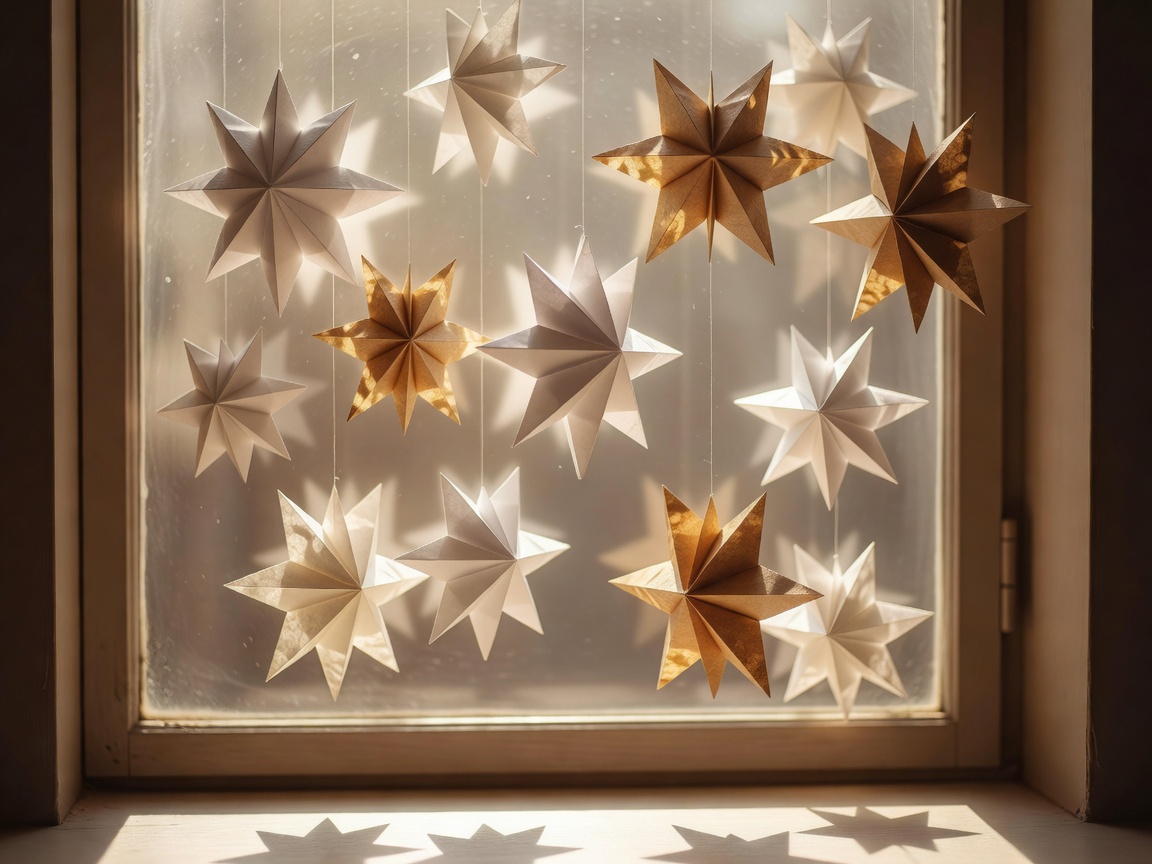
Why paper belongs at Christmas
Long before glass baubles were affordable, households across Northern Europe decorated with paper. In Denmark, woven paper hearts, or julehjerter, have hung on trees since the nineteenth century; the oldest surviving example is often attributed to Hans Christian Andersen, whose papercuts are held by the Odense City Museums. In Poland, folk artists cut bold symmetrical wycinanki from coloured paper, while German and Swiss makers developed the fine silhouette tradition known as Scherenschnitte. Mexico's papel picado banners, cut from tissue paper, show the same instinct: transform a fragile sheet into something celebratory.
The folded star many families call a Fröbel star takes its name from Friedrich Fröbel, the German educator who founded the kindergarten and championed paper folding as learning through hands. And in Japan, the art of origami was given a shared written language by Akira Yoshizawa, whose diagram symbols are still used in folding books worldwide. You do not need to master any of these traditions to borrow their spirit.
Look at papercuts in museum collections such as the Victoria and Albert Museum in London online. Notice how much they achieve with a single colour and plenty of empty space. That restraint is what makes a room feel cohesive.
Sourcing paper you already own
Begin with a paper hunt. Brown kraft paper from parcel deliveries folds crisply and pairs beautifully with red thread. Out-of-date maps, sheet music from charity shops, children's outgrown drawing books and the plain backs of wrapping paper all work. Old Christmas cards are stiff enough for gift tags and star centres. Avoid glossy magazine paper for weaving: it cracks along folds. If you must buy, choose a single pack of 80 to 120 gsm coloured paper in two shades so everything you make shares a palette.
Iron creased paper flat on a low, dry setting under a tea towel, and cut everything into neat rectangles before you start. A stack of prepared strips turns a craft session into calm assembly rather than hurried cutting.
Project: a woven Danish heart
Usable instructionsSupplies
- Two contrasting papers, each cut to 8 × 20 cm
- Pencil, ruler and sharp scissors
- Glue stick and a 15 cm length of thread or narrow ribbon
- A paper template: draw a rectangle with one rounded end
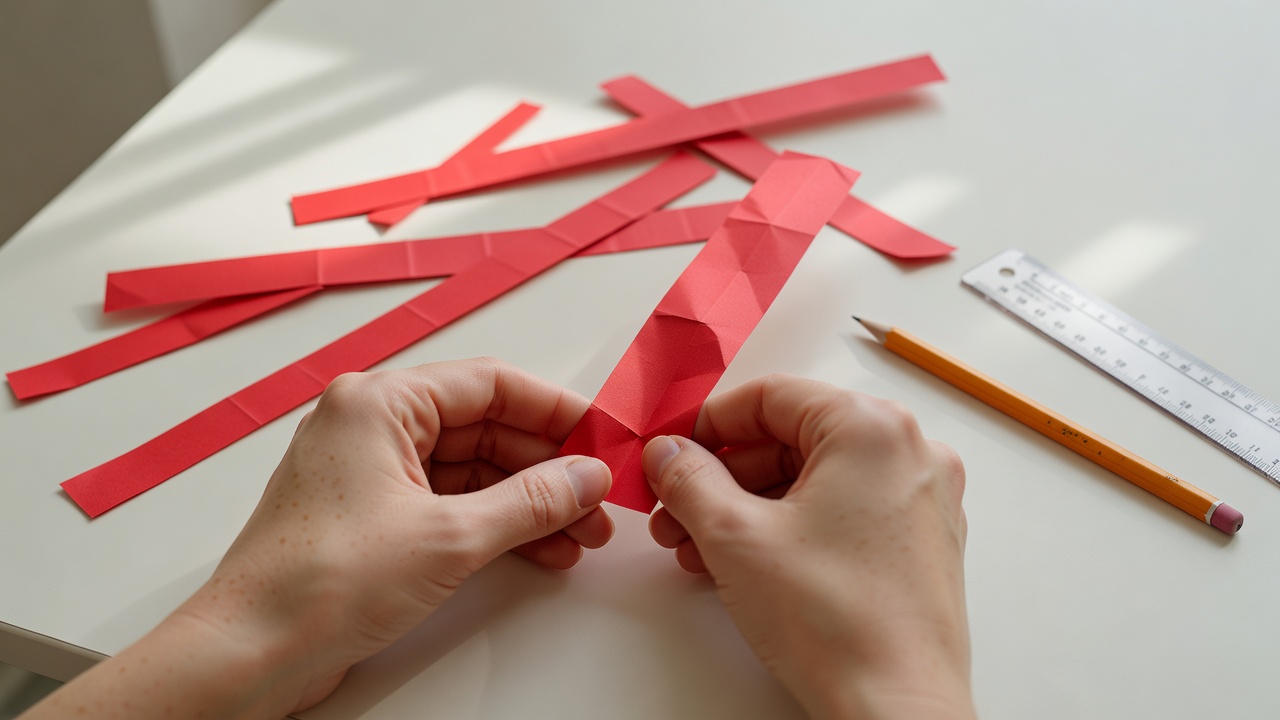
- Fold each paper in half widthways so you have two 8 × 10 cm doubled pieces. The fold is the bottom of the heart lobe.
- Round off the open end of each piece with scissors so it resembles a tongue shape.
- From the folded edge, draw two lines towards the rounded end, dividing the width into three equal strips. Stop about 2 cm before the curve begins.
- Cut along both lines through both layers. You now have three looped strips on each piece.
- Hold the pieces at a right angle. Weave the first strip of one piece through the first loop of the other, then around the second, then through the third: through, around, through.
- Take the next strip and reverse the pattern: around, through, around. Ease the loops gently rather than forcing them.
- Repeat for the third strip, then push the woven area down so it sits neatly. The heart now opens into a little basket.
- Glue a thread handle inside the top edges and leave flat for ten minutes before hanging.
Once you are comfortable, try four or five strips for a checkerboard effect. Hearts filled with walnuts or wrapped sweets make lovely table place markers.
Quick variations
A paper chain becomes elegant when every link is cut from the same map or music score. A simple accordion fan, pinched in the middle and glued to its neighbour, creates a rosette in minutes. For a Moravian-inspired star, the Herrnhut stars from Saxony are made of many pointed cones; a paper version using six cones glued to a card circle gives a similar silhouette without complex geometry.
Storing paper decorations
Paper fades in sunlight and softens in damp lofts. Store flat pieces between sheets of plain card inside a document box, and nest woven hearts in an egg carton so they keep their shape. Add a note listing what is inside and who made it. Damaged pieces can be cut down into gift tags or composted if they are uncoated paper.
Troubleshooting
My heart strips will not weave without tearing.
Your paper is probably too thick or the cuts stop too close to the curve. Use paper under 120 gsm and leave a 2 cm uncut band.
The two halves look lopsided.
Cut one piece, then use it as a template for the second so both strips align exactly.
My stars keep unfolding.
Crease with a bone folder or butter knife and add a dot of glue at the final tuck.